Droxalvi
Axis Set
Axis Set
Couldn't load pickup availability
1. Problem Statement
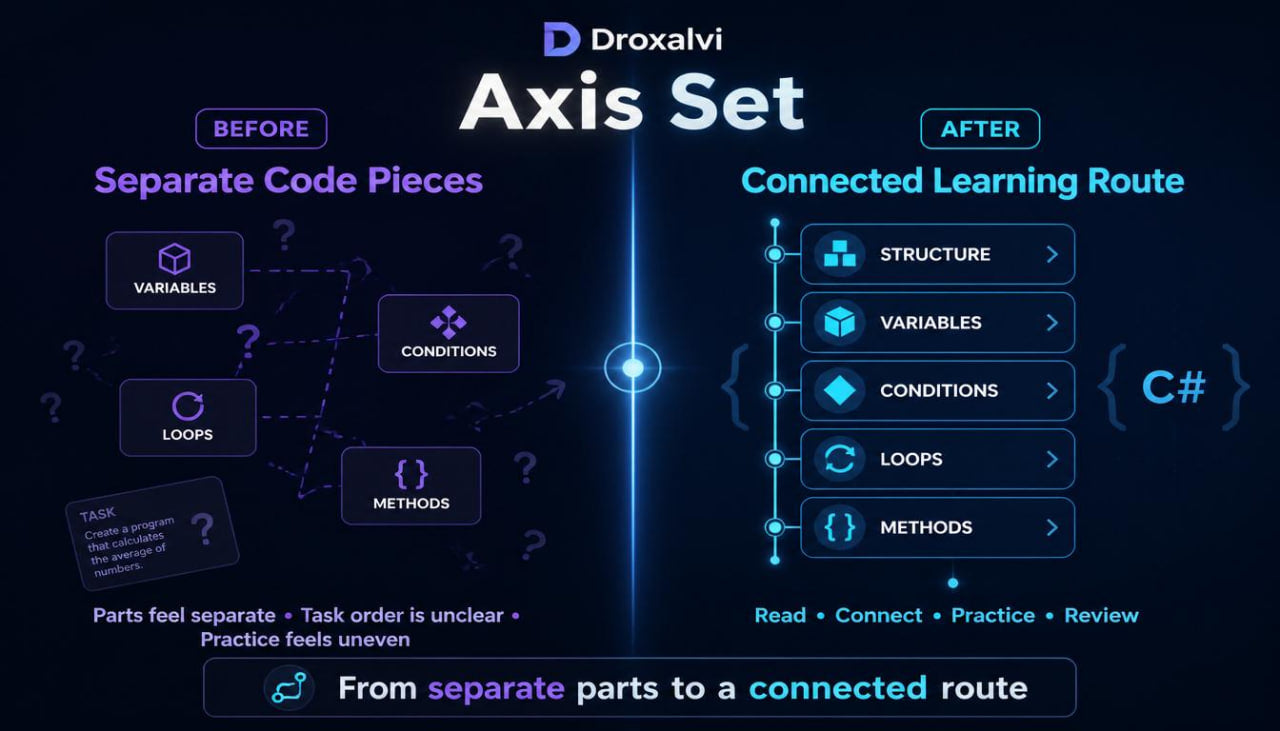
After the first introduction to C#, a learner may understand separate parts of code but still not see the full logic between them. Variables may be clear on their own, conditions may be clear on their own, and loops may be clear on their own, but when writing an example, all of them may start to feel mixed together. Because of this, even a simple task may feel uncomfortable, since the learner may not know where to begin or how to divide the task into smaller actions. Another difficulty is that many materials present topics in a fragmented way, without a learning route. Axis Set was created to help the learner connect basic C# elements into a clear system.
2. Solution
Axis Set offers a steady study of C# basics, where each topic is connected to the previous one. The materials do not only explain syntax; they show how to use it in short training examples. The learner gradually moves from reading code to changing examples, and then to building small fragments independently. This format helps explain why code is written in one way rather than another. The plan suits learners who have already reviewed starter materials and want to continue in a more organized rhythm.
3. What’s Inside
Axis Set includes a learning set that expands the basic introduction to C# and helps the learner work more comfortably with simple constructions. The main focus of this plan is not the number of topics, but the order: each section includes an explanation, an example, a breakdown, and a practical task.
The first section returns to the basic structure of C#. The learner reviews familiar elements: code blocks, braces, names, commands, and execution order. This time, these elements are not shown as separate details, but as parts of one training example. This helps show how code is read from top to bottom and how one action can affect the next one.
The second section looks at variables in more detail. The materials explain why a variable name should be clear, how a value is stored in code, and why a data type affects later actions. The learner works with numbers, text values, and logical values in small examples. A separate part shows how to change a variable value and observe how this changes the behavior of the example.
The third section focuses on conditions. Here, the learner studies simple choice logic: when the code should perform one action and when it should perform another. The materials show how to compare values, how to write checks, and how to build short code branches. The examples are created for study, without complex scenarios, so the focus stays on condition logic.
The fourth section introduces loops through repeated actions. The learner sees how a loop can be used to repeat the same code block several times. The materials explain the role of a counter, a starting value, a stopping condition, and the value change after each repetition. This helps the learner understand the movement of loop logic, not only memorize the written form.
The fifth section introduces methods at a basic stage. The learner studies why a part of code can be moved into a separate block, how to name a method, and how to call it in another place. The examples show how a method can make code cleaner and more readable. The section also explains the difference between a method that only performs an action and a method that returns a value.
The sixth section includes practical tasks that combine several topics. The learner works with short exercises where variables, conditions, loops, and methods are used together. For example, a task may ask the learner to create a small calculation, check a value, or repeat an action several times. Everything is presented in a training format, so the learner can calmly review each step.
The seventh section includes a review of common beginner mistakes. It explains why a missing brace, an incorrect variable name, or an unsuitable data type can change code behavior. The learner sees mistakes not as something alarming, but as part of the study process. This helps build careful code reading and attention to small details.
Axis Set also includes short summaries after each block. They help return to the main ideas without reading the whole section again. There are also study notes with terms, task wording examples, and mini-checks for material review.
4. Who is this for?
Axis Set is for learners who have already taken their first look at C# and want to move into more organized study. This plan may be useful for those who understand what a variable or a condition is, but do not always see how these parts work together in an example.
It also suits people who want to review basic topics without overly complex wording. When a learner has tried reading code before but felt lost in details, Axis Set helps return to the basics through short explanations and practical exercises.
This plan does not require deep preparation. It is created for calm movement from simple fragments to connected training examples. It is especially suitable for learners who want to see not only a rule, but also how that rule works inside a small task.
5. What You’ll Learn
After studying Axis Set, the learner will understand the main C# constructions better and use them in short training examples.
- How to read the basic structure of a C# example
- How to work with variables in training code
- How to distinguish simple data types
- How to build basic conditions
- How to use comparisons in short checks
- How a counter-based loop works
- How to repeat an action through a simple loop construction
- How to create basic methods
- How to call a method in the needed place
- How to combine variables, conditions, loops, and methods
- How to read beginner-stage mistakes
- How to divide a simple task into smaller steps
- How to work with exercises after explanations
- How to complete a short review after each block
6. Purchase Terms
Axis Set is one of the paid Droxalvi plans. This plan includes a 30-day period during which the buyer may submit a payment review request according to store terms.
Self-paced learning overview
- 🗂️ Digital file available after purchase
- 📚 Long-term availability
- 🔐 Secure checkout
- 📝 Content updated in 2026
What is included in Droxalvi learning materials?
What is included in Droxalvi learning materials?
The materials include structured lessons, explanations, code examples, practical tasks, short summaries, and study notes. Each plan has its own topic range and level of detail.
Are these courses suitable for beginners?
Are these courses suitable for beginners?
Yes, the first plans are created for an introduction to C# without heavy wording. The materials gradually introduce basic ideas, syntax, variables, conditions, loops, and work with simple examples.
How does the learning process work?
How does the learning process work?
The learner studies at a personal pace, moving from explanation to example, and then to a practical task. This format helps build understanding through order and repetition.
Share