Droxalvi
Free Kit
Free Kit
Couldn't load pickup availability
1. Problem Statement
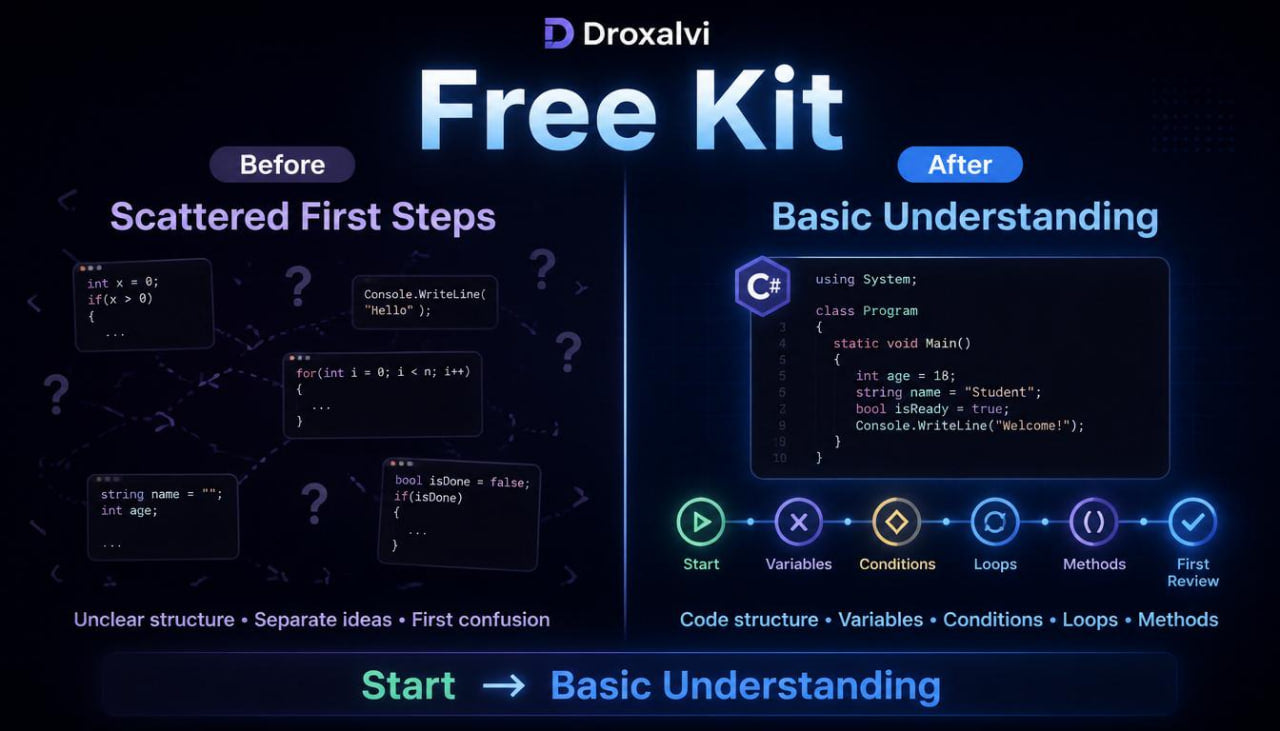
Starting with C# can feel confusing because a new learner often sees many terms, rules, and code fragments without a clear order. Even basic topics may seem heavy when variables, data types, conditions, and methods are shown without a steady learning flow. Many materials move into large examples too early, while a learner first needs to understand how code is read and why it works in a certain way. Because of this, C# may look like a set of separate details that are hard to connect into one system. Free Kit was created to give a gentle first step and show the basic logic of the Droxalvi course format without overload.
2. Solution
Free Kit presents C# through short explanations, study examples, and small practical exercises. The materials are organized so the learner can move gradually from general understanding to specific code fragments. First, the idea of the topic is explained, then an example is shown, and after that, a small task is offered for personal practice. This approach helps the learner not only read the text but also see the link between a rule and its use. This plan works well as the first entry point into Droxalvi because it introduces the course format and the basic language of C#.
3. What’s Inside
Free Kit includes a compact set of materials that introduces the learner to C# basics and the Droxalvi learning style. It is not a large course with many topics, but a starter format that helps show how the explanations are structured, how examples are presented, and how the first training tasks are completed.
The first block introduces the general structure of C#. It explains what a code structure is, how to read a sample file, why braces matter, and how lines, commands, and order work together. The learner sees not just a group of symbols, but the logic behind a code fragment.
The second block introduces basic data types. The materials explain the difference between numbers, text values, logical values, and simple variables. The examples are based on study situations, so the learner can understand why a variable has a name, a value, and a type.
The third block focuses on conditions. The learner sees how basic checks work, how code reacts to different values, and how simple choice logic can be described. This section avoids complex constructions and focuses on one idea: when a condition is met, the code follows one path; when it is not met, it follows another path.
The fourth block introduces loops at a starter level. It explains why an action may need to be repeated several times and how such repetition is written in code. The examples help show how a loop can work with numbers, a counter, or a short group of values.
The fifth block includes the first practical tasks. They are not created for heavy testing, but for calm repetition. The learner can rewrite an example, change values, add a personal line, or explain what each part of the code does. This format helps reinforce the basic ideas.
The materials also include short summaries after each topic. They help return to the main ideas without reading the whole section again. There is also a small glossary where basic terms are explained, especially the words that often appear at the beginning of C# learning.
Free Kit does not overload the learner with a large amount of content. Its role is to give a first orientation point, show the Droxalvi learning structure, and help with the first steps in C# through clear materials.
4. Who is this for?
Free Kit is for people who are just starting to explore C# and want to understand whether this learning direction fits them. It may also be useful for learners who have seen code fragments before but do not yet have a clear idea of how those fragments connect. This plan can be chosen as a first trial format before moving to wider Droxalvi materials.
It suits learners who prefer calm explanations without pressure or exaggerated claims. The materials are created for gradual study of the topic, not for a sudden jump into complex tasks. When a person needs to see the course structure, explanation style, and task format, Free Kit is a suitable first step.
This plan may also be convenient for those who compare several learning formats and want to begin with a short set of materials. It does not require prior preparation and does not overload the learner with terms. The focus is placed on basic ideas, reading examples, and simple C# logic.
5. What You’ll Learn
After working with Free Kit, the learner will better understand the basic structure of C# and how first study examples are built.
- How a basic C# fragment is structured
- Why variables and data types are used
- How to read simple lines of code
- How a basic condition works
- How repetition is described through a loop
- How to change an example and observe the logic
- How to work with short study tasks
- How to use summaries after topics
- How to recognize basic C# terms
- How to prepare for wider Droxalvi materials
6. Purchase Terms
Free Kit is a no-cost plan, so no payment is required to receive the materials. Paid Droxalvi plans include a 30-day refund period according to store terms.
Self-paced learning overview
- 🗂️ Digital file available after purchase
- 📚 Long-term availability
- 🔐 Secure checkout
- 📝 Content updated in 2026
What is included in Droxalvi learning materials?
What is included in Droxalvi learning materials?
The materials include structured lessons, explanations, code examples, practical tasks, short summaries, and study notes. Each plan has its own topic range and level of detail.
Are these courses suitable for beginners?
Are these courses suitable for beginners?
Yes, the first plans are created for an introduction to C# without heavy wording. The materials gradually introduce basic ideas, syntax, variables, conditions, loops, and work with simple examples.
How does the learning process work?
How does the learning process work?
The learner studies at a personal pace, moving from explanation to example, and then to a practical task. This format helps build understanding through order and repetition.
Share