Droxalvi
Halo Guide
Halo Guide
Couldn't load pickup availability
1. Problem Statement
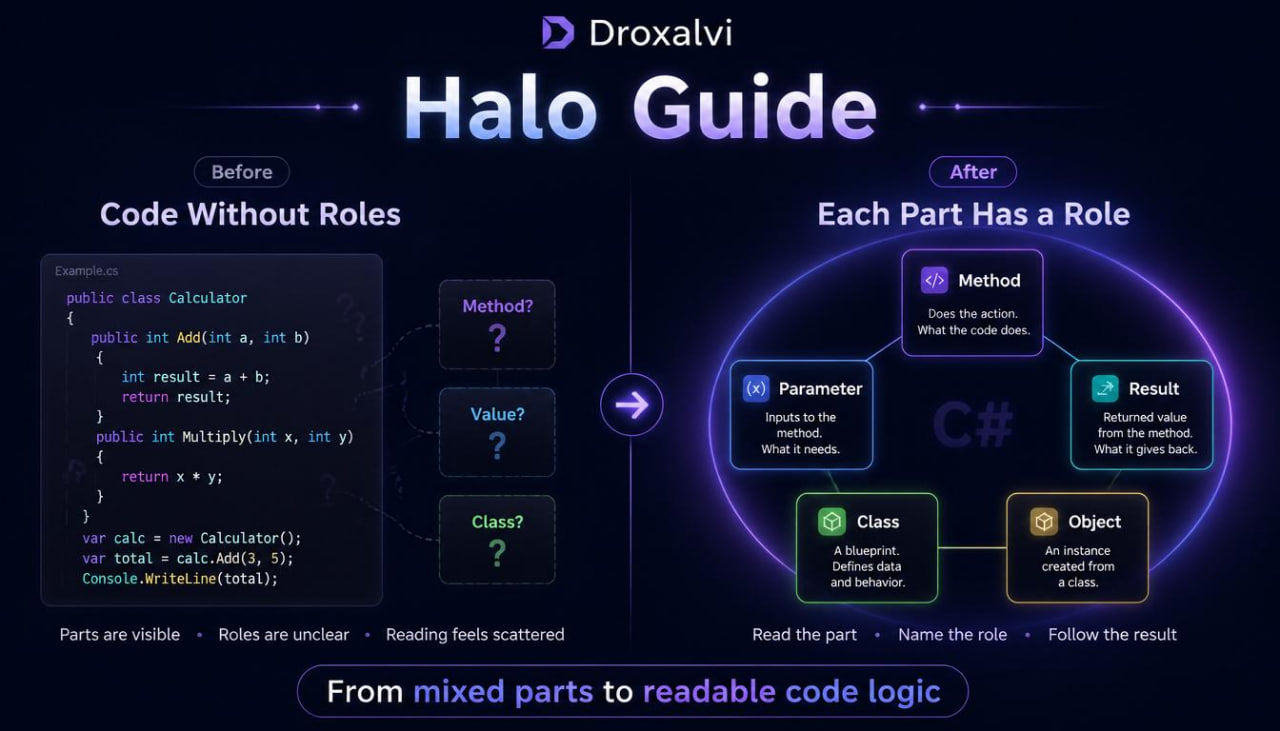
When the learner moves from basic exercises to longer C# examples, it is no longer enough to know only variables, conditions, and loops. Code begins to include methods, parameters, returned values, simple classes, and links between different parts of an example. Without careful explanation, these topics may feel disconnected: a method on its own, a class on its own, and task logic on its own. The learner may copy a prepared example but not always understand why the structure is built in that way. Halo Guide was created to help review C# examples more deeply, while avoiding a sudden move into complex theory.
2. Solution
Halo Guide presents C# through detailed explanations, logic review, and gradual introduction of more organized topics. The materials show how methods help divide actions, how parameters pass data, how values are returned, and how a class can hold connected parts of an example. The learner works with short training tasks where each block has a clear role. After an explanation comes an example, after the example comes a review, and after the review comes a task for repetition. This format helps the learner see C# not as a set of separate rules, but as a structured system of learning actions.
3. What’s Inside
Halo Guide includes an expanded learning set where the main focus is placed on methods, parameters, returned values, simple classes, and code reading. This plan continues the topics from previous sets, while adding more explanation on how to build examples in a cleaner and more readable way.
The first block reviews the role of methods in C#. The learner studies why a part of the code can be moved into a separate method, how to name an action, and how to make an example more convenient to read. The materials show how a method can perform one specific task: check a value, prepare text, make a calculation, or return a result. This helps avoid mixing many actions in one place.
The second block looks at parameters. The learner studies how data is passed into a method, why parameters have names and types, and how they are used inside the method. The examples are built so the link between the passed value and the action performed by the method can be seen clearly. A separate explanation shows why one method can work with different values when its structure is built properly.
The third block focuses on returned values. The learner sees the difference between a method that simply performs an action and a method that calculates or prepares a result for later use. The materials show how a returned value can be stored in a variable, passed to another part of the example, or used in a condition. This is an important step for understanding how code can move a result between different blocks.
The fourth block introduces simple classes. Here, the learner studies a class not as a complex topic, but as a way to keep connected data and actions in one place. The materials explain what a class name, fields, properties, and simple methods inside a class are. The examples use training objects with a small number of characteristics, so the learner can see the general idea without overload.
The fifth block focuses on creating a simple object. The learner sees how a class is used to describe a structure, while an object is used to work with specific values. The materials show how to set data, change it, read a value, and use a method that belongs to that object. This block helps explain the difference between a description and a specific example in code.
The sixth block reviews the combination of classes, methods, and conditions. The learner works with examples where data is stored in an object, a method performs an action, and a condition defines the next step. These examples remain training-based, but they give a stronger sense of code movement. The materials explain how not to overload a class with extra actions and how to keep each part in a clear role.
The seventh block contains practical exercises for review. First, the learner reads a prepared example and explains what each method does. Then the learner adds a parameter, changes a returned value, or moves part of the logic into a separate method. After that, the exercises introduce simple classes: create a structure, describe several values, add a short action, and use an object in an example. Each task includes a review that explains the structure logic.
Halo Guide also includes study tables and notes. They show the difference between a method without a returned value, a method with a result, a parameter, a property, and a field. There are also blocks with common mistakes: incorrect value passing, confusion between a method name and a variable name, extra logic inside a class, or unclear example structure. These materials help the learner read code more carefully and notice how one part affects another.
4. Who is this for?
Halo Guide is for learners who are already familiar with basic C# constructions and want to move into topics where code has a more visible structure. This plan fits those who have already worked with variables, conditions, loops, and methods, but want to better understand parameters, returned values, and simple classes.
It also suits learners who can repeat a prepared example but want to learn how to explain it in their own words. The materials give much attention to code reading, logic review, and understanding the role of each block. This is useful for learners who want not only to complete an exercise, but also to understand why the example is built in this way.
Halo Guide may be a convenient choice for those who want to move from basic topics to an object-based approach without a sudden increase in complexity. Classes are presented through simple training situations where each part has an explanation and an example.
5. What You’ll Learn
After working with Halo Guide, the learner will better understand methods, parameters, returned values, and first examples with classes in C#.
- How to understand the role of a method in a training example
- How to create a method for a separate action
- How to pass data through parameters
- How parameter names and types work
- How to distinguish a method with a result from a method without a result
- How to store a returned value in a variable
- How to use a method result in a condition
- How to read a simple class in C#
- How to understand fields, properties, and methods inside a class
- How to create a simple object with given values
- How to combine objects, methods, and conditions
- How to explain example logic in personal wording
- How to find an extra or unclear part in code
- How to complete training exercises with methods and classes
6. Purchase Terms
Halo Guide is one of the paid Droxalvi plans. This plan includes a 30-day period during which the buyer may submit a payment review request according to store terms.
Self-paced learning overview
- 🗂️ Digital file available after purchase
- 📚 Long-term availability
- 🔐 Secure checkout
- 📝 Content updated in 2026
What is included in Droxalvi learning materials?
What is included in Droxalvi learning materials?
The materials include structured lessons, explanations, code examples, practical tasks, short summaries, and study notes. Each plan has its own topic range and level of detail.
Are these courses suitable for beginners?
Are these courses suitable for beginners?
Yes, the first plans are created for an introduction to C# without heavy wording. The materials gradually introduce basic ideas, syntax, variables, conditions, loops, and work with simple examples.
How does the learning process work?
How does the learning process work?
The learner studies at a personal pace, moving from explanation to example, and then to a practical task. This format helps build understanding through order and repetition.
Share