Droxalvi
Vertex Archive
Vertex Archive
Couldn't load pickup availability
1. Problem Statement
At the middle stage of learning C#, the learner often has many separate pieces of knowledge but may not always remember where and how to use them. One topic may feel clear while reading, but during a practical task, confusion can appear between methods, classes, collections, and conditions. It can also be difficult to return to a completed topic when the materials are not arranged in a convenient system. Because of this, learning may feel like a set of separate blocks rather than a steady route. Vertex Archive was created to help the learner organize previous topics and work with them in a more collected way.
2. Solution
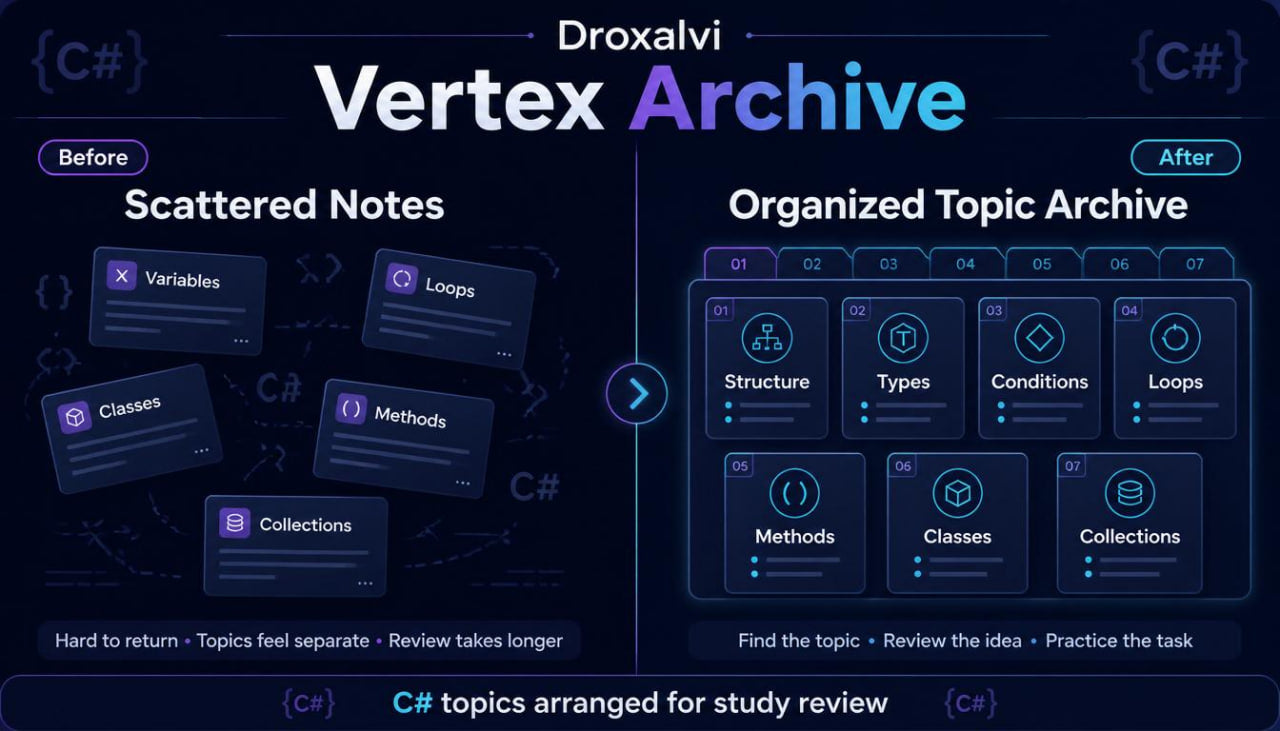
Vertex Archive presents C# as a learning archive of topics, where each section has its place, explanation, example, and practical task. The materials help return to important ideas without searching chaotically through different parts of the course. The learner sees how basic topics connect with broader examples: variables with conditions, loops with collections, methods with classes, and classes with data organization. Each block is built so it can be studied separately or used for review. This format fits gradual knowledge building and more attentive work with code.
3. What’s Inside
Vertex Archive includes a large learning set that joins several C# topic groups into an organized structure. Its main idea is not only to add more materials, but to help the learner return to completed topics conveniently, compare topics with each other, and see links between different parts of code.
The first block reviews the basic structure of C#. The learner returns to fundamental ideas: code lines, blocks, braces, names, execution order, and basic writing rules. Here, these topics are presented as a reference section with examples, which can be used while working with other exercises. This helps keep the base visible when broader topics appear.
The second block focuses on variables and data types. The materials explain how to understand the role of a variable in a task, how to choose a type for a value, and how not to confuse different kinds of data. There are examples with numbers, text values, logical values, and small calculations. A separate part reviews common cases where a mistake appears because of a type mismatch or an unclear variable name.
The third block focuses on conditions and logical checks. The learner works with basic conditions, several choice variants, nested checks, and combining conditions with other parts of code. The materials show how a condition can change the flow of an example, how to avoid extra branches, and how to read check logic from top to bottom. This is useful for tasks where code needs to react to different values.
The fourth block reviews loops and repetition. It explains how different repeated actions work, how to use a counter, how to move through a group of values, and how to combine a loop with a condition. The learner sees examples where a loop does not only repeat an action, but gradually forms a result, checks elements, or works with a training list.
The fifth block focuses on methods and parameters. The materials help explain how to move part of the logic into a separate method, how to pass data through parameters, and how to return a value for later use. There are examples of methods for checking, calculating, preparing text, and working with simple values. Special attention is given to making each method have a clear role without mixing many different actions.
The sixth block looks at classes and objects at a learning stage. The learner sees how a class can describe a data structure, while an object stores specific values. The materials explain fields, properties, methods inside a class, and simple ways to work with an object. The examples stay short, but they already show how data and actions can be kept in one place.
The seventh block introduces collections and basic processing of value groups. The learner works with lists of training numbers or text values, studies moving through elements, searching for a needed value, counting items, and simple result collection. The materials show how collections connect with loops, conditions, and methods.
A separate part of Vertex Archive includes reference tables. They contain short explanations of syntax, examples of conditions, loops, methods, parameters, properties, and actions with collections. There are also review blocks where the learner can return to a topic before completing a practical task.
Another important part of this plan is the comparison section. It explains the difference between a variable and a parameter, a method and a class, a field and a property, a loop and a condition, a list and a single value. These comparisons help reduce confusion and show more clearly what role each part of code performs.
The practice part includes exercises for review and topic combination. The learner can work with prepared fragments, find mistakes, complete methods, change conditions, or create small structures with classes. The tasks are not built around haste; they are created for attentive study and review.
4. Who is this for?
Vertex Archive is for learners who have already studied basic C# topics and want a more organized set of materials for review and further practice. This plan may be useful for those who know variables, conditions, loops, methods, and classes, but want to see the links between these topics more clearly.
It also suits people who often return to previous material and want a learning structure with explanations, tables, examples, and exercises. Vertex Archive does not present topics as a random set of pages, but gathers them into a steady archive for review.
This plan may be convenient for learners who want to work with C# more systematically. The materials fit those who want not only to read new topics, but also to return to earlier ideas, compare them, and use them in training tasks.
5. What You’ll Learn
After working with Vertex Archive, the learner will be able to navigate core and broader C# study topics more comfortably.
- How to review basic C# structure through reference blocks
- How to understand the role of variables in different tasks
- How to work with data types in training examples
- How to build conditions and logical checks
- How to read nested checks without confusion
- How to use loops for repeated actions
- How to move through a group of values
- How to create methods with parameters
- How to return values from a method
- How to read simple classes and objects
- How to understand fields, properties, and class methods
- How to work with basic collections
- How to combine collections with conditions and loops
- How to compare similar C# ideas
- How to use reference tables for review
- How to complete exercises that combine several topics
6. Purchase Terms
Vertex Archive is one of the paid Droxalvi plans. This plan includes a 30-day period during which the buyer may submit a payment-related request according to store terms.
Self-paced learning overview
- 🗂️ Digital file available after purchase
- 📚 Long-term availability
- 🔐 Secure checkout
- 📝 Content updated in 2026
What is included in Droxalvi learning materials?
What is included in Droxalvi learning materials?
The materials include structured lessons, explanations, code examples, practical tasks, short summaries, and study notes. Each plan has its own topic range and level of detail.
Are these courses suitable for beginners?
Are these courses suitable for beginners?
Yes, the first plans are created for an introduction to C# without heavy wording. The materials gradually introduce basic ideas, syntax, variables, conditions, loops, and work with simple examples.
How does the learning process work?
How does the learning process work?
The learner studies at a personal pace, moving from explanation to example, and then to a practical task. This format helps build understanding through order and repetition.
Share